India’s renewable surge has outpaced its ability to store power, exposing a critical gap that could shape the next phase of its energy transition.
By Ankush Kumar
India’s clean energy story is often told through the rapid rise of solar and wind power. Capacity is expanding at pace, targets are being met ahead of schedule, and the country is positioning itself as a key player in the global decarbonization effort. Yet beneath this progress lies a quieter, unresolved challenge: how battery storage systems could be used to capture all that clean power.
The scale of India’s transition is undeniable. The country has crossed 500 gigawatts (GW) of installed electricity capacity, placing it among the world’s largest power systems. As of March 2026, non-fossil fuel capacity stood at 283.46 GW, accounting for roughly half of the total, five years ahead of its 2030 climate commitments.
Government data reflects the speed of this shift. India added 55.3 GW of non-fossil capacity in FY 2025–26, while renewable energy met over half of peak electricity demand in July 2025. Speaking at the release of the latest renewable energy statistics, Energy Minister Pralhad Joshi noted that India now ranks third globally in renewable energy installed capacity. However, while generation has surged, battery storage has not kept pace.
A system growing faster than its flexibility
Across much of the world, batteries are becoming central to decarbonization, helping grids absorb renewable energy and reduce dependence on fossil fuels. In India, however, coal and large hydro still provide most of the flexibility needed to keep the system stable. That gap is becoming harder to ignore.
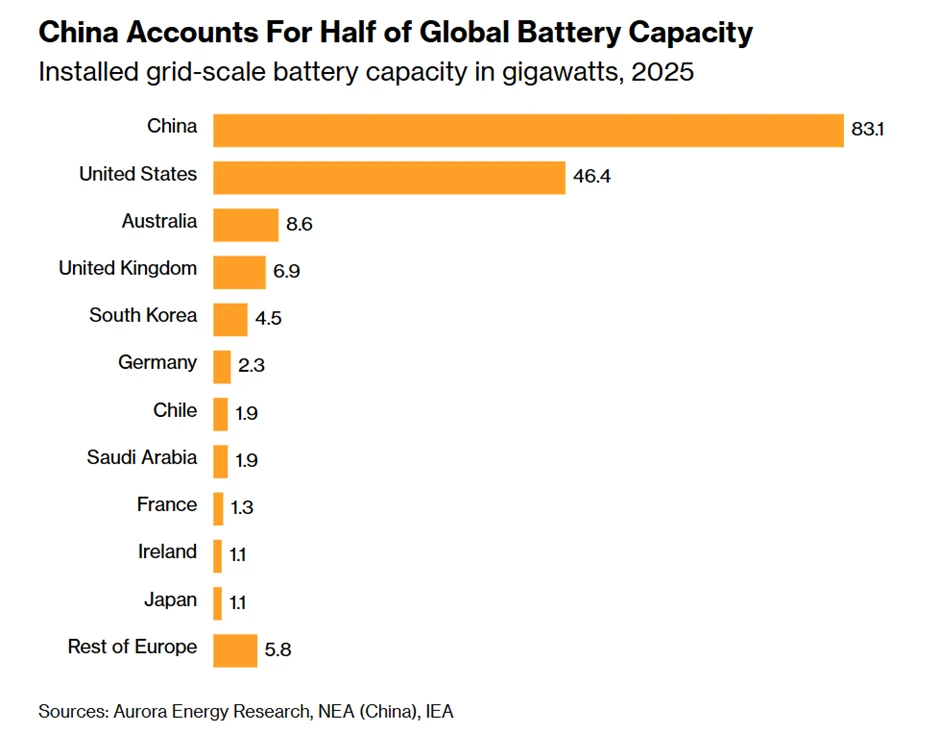
Countries like China and the United States have moved aggressively to deploy battery storage at scale. India, by comparison, is still at an early stage, with limited operational capacity despite a growing pipeline of projects.
The contrast highlights a deeper issue: India has made rapid progress in clean energy deployment, but the systems needed to support long-term decarbonization—particularly storage—are still catching up.
A widening gap between ambition and execution
On paper, the ambition is clear. India’s power planners estimate that the country will need around 411 gigawatt-hours (GWh) of energy storage by 2031–32 to integrate its expanding solar and wind capacity. A significant portion of this is expected to come from battery systems, underlining their importance in the next phase of decarbonization.
There are early signs of movement. Hybrid tenders—combining renewable energy with battery storage—are gaining traction. According to the Institute for Energy Economics and Financial Analysis (IEEFA), their share has jumped from about 12 per cent in 2021 to over 49 per cent in 2024.
Momentum is also building on the deployment side. The India Energy Storage Alliance (IESA) expects battery storage capacity additions to rise sharply, from about 507 MWh in 2025 to nearly 5 GWh in 2026, marking a significant step-up in activity. The industry body describes 2026 as a potential inflection point, with around 60 GWh of projects moving into the implementation phase as the market shifts from tendering to execution. Yet progress on the ground remains uneven.
While India has auctioned large volumes of battery storage capacity in recent years, only a small share has been commissioned so far. Delays in project execution, financing challenges, and evolving market structures continue to slow deployment. Analysts point to aggressive bidding, transmission bottlenecks, and uncertainty around revenue models as key barriers.
This creates a familiar pattern in India’s decarbonization journey: strong policy signals and ambitious targets, but slower real-world implementation.
Where the grid is already under strain
The consequences are already visible, not just in data, but in daily life. As solar capacity rises, India’s power system is beginning to exhibit the classic “duck curve,” a midday dip in demand followed by a steep evening peak. Managing this shift is becoming one of the central challenges of decarbonization.
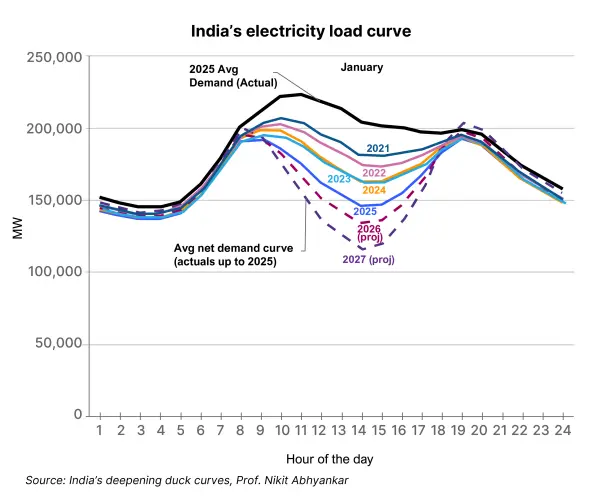
In places like Indirapuram, near Delhi, this strain shows up in frequent power tripping during peak hours. Residential complexes often fall back on diesel generators, a costly and polluting backup that undercuts broader decarbonization goals.
Further from the mainland, around 1200 kilometres, in the Andaman Islands, the situation is starker. With no central-grid connection, the region relies mostly on diesel. Even high-end resorts experience repeated outages, pointing to the limitations of existing infrastructure. Here, renewable energy paired with storage could provide a cleaner and more reliable alternative, but adoption remains limited.
Across these very different contexts, the pattern is the same: when reliability is at stake, diesel still fills the gap. Battery storage, in theory, could change that.
Globally, the technology is scaling rapidly. The International Energy Agency notes that battery storage was the fastest-growing power technology in 2025, with deployments rising sharply across major markets. Costs are falling, and new business models are emerging to support integration with renewable energy.
In India, however, the economics are more complex. Unlike electric vehicles, where clear fuel savings drive battery adoption, grid-scale storage depends on multiple revenue streams, from price arbitrage to grid services. These markets are still evolving, and distribution companies remain cautious given their financial constraints.
This has slowed the pace at which storage can contribute meaningfully to decarbonization.
At the same time, waiting comes with its own risks. Without storage, solar power generated during the day cannot always be used when demand peaks in the evening. The result is curtailment of clean energy and continued reliance on fossil fuels, an outcome that runs counter to India’s broader decarbonization ambitions.
The country’s absence from the global leaders in battery storage is therefore not about a lack of intent. It reflects a transition still in progress, one where the focus has so far been on building capacity, rather than flexibility.
That balance is now beginning to shift. As renewable energy continues to expand, the need for storage will become harder to defer. Whether India can accelerate deployment in time will shape not just the reliability of its power system, but the effectiveness of its long-term decarbonization strategy.
The question is no longer just how much clean power India can generate, but how well it can store, manage, and use it through batteries.