India’s renewable energy boom is testing the limits of grid flexibility as electricity demand rises, heat waves intensify, and policymakers search for alternatives to a gas-dependent transition.
By Ankush Kumar
India’s power system is entering a decisive phase where power grid flexibility is becoming the central challenge of its energy transition. Data from the Ministry of New and Renewable Energy (MNRE) show that the country added 55.3 GW of non-fossil fuel capacity in FY2025–26, pushing total installed non-fossil capacity to 283.46 GW by March 2026. India has also moved into third place globally in renewable energy installed capacity, overtaking Brazil, according to Renewable Energy Statistics 2026 published by the International Renewable Energy Agency (IRENA).
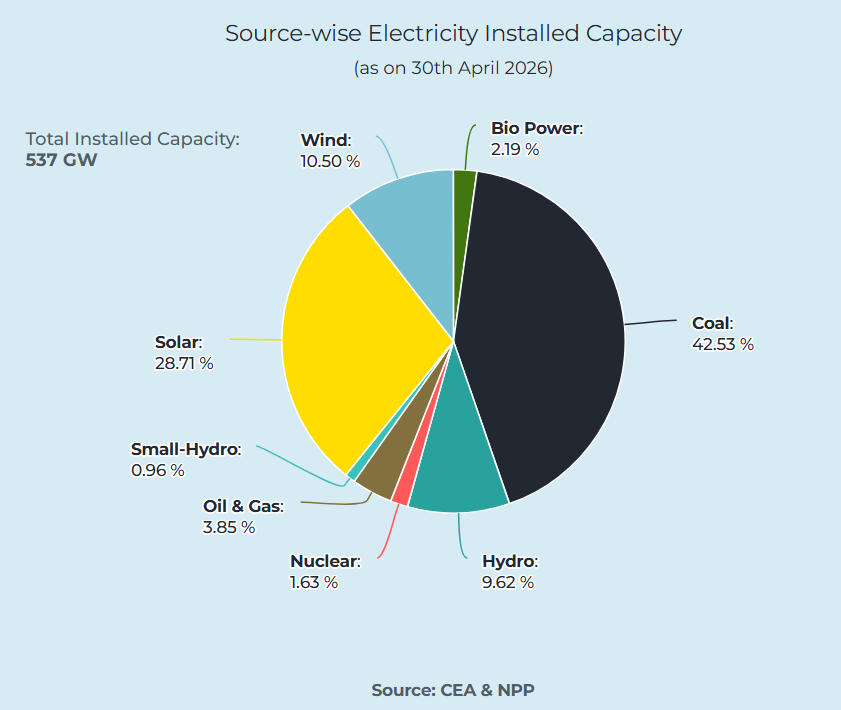
According to Central Electricity Authority (CEA) data, non-fossil sources accounted for 52.57% of India’s installed capacity as of February 2026, compared with 47.43% from fossil fuels. Solar accounted for 27.4% of total installed capacity, while wind contributed 10.5%.
The scale of renewable integration is already becoming visible. In July 2025, renewable energy sources met 51.5% of electricity demand during a peak period when national demand reached 203 GW—the highest-ever share of renewables in India’s power mix, according to MNRE.
At the same time, rising temperatures are placing unprecedented pressure on the electricity system. Peak demand has climbed from around 180 GW in 2019 to a record 270 GW in 2026, according to the International Energy Agency (IEA)—an increase that exceeds France’s total peak electricity demand. The latest peak was recorded on May 21, when temperatures across parts of northwestern and central India ranged between 40°C and 47°C, with some locations touching 48°C.
These developments are reshaping the energy transition debate. The challenge is no longer simply adding renewable capacity. It is ensuring grid stability as weather-dependent power sources account for a growing share of generation.
Why Power Grid Flexibility Has Become the Core Constraint
Yet installed capacity does not tell the whole story. Coal still supplies roughly 70% of India’s electricity because it provides firm power during periods of high demand and low renewable output. The gap between installed renewable capacity and actual generation highlights a central challenge facing power systems worldwide: intermittency.
Electricity demand continues to rise as urbanization, industrial electrification, digital infrastructure expansion, and cooling requirements intensify. Climate change is amplifying this pressure, with more frequent heat waves driving higher consumption across households, services, and industry.
As a result, grid operators are placing greater emphasis on flexibility. Coal plants—traditionally designed for baseload operation—are increasingly required to operate dynamically to support renewable integration.
Since 2019, policymakers and system planners have explored “flexible coal” operations to improve responsiveness. Government discussions have proposed reducing minimum technical load requirements for coal-based thermal plants from 55% toward 40%, according to information released by the Press Information Bureau.
The operational shift is already visible. According to the IEA, India’s coal fleet provided about 45 GW of ramping flexibility on May 21, reducing output during midday to accommodate solar generation before ramping up in the evening as solar output declined and air-conditioning demand surged. Coal plants reached nearly 92% of available capacity during the evening peak, underscoring their continued role in system reliability.
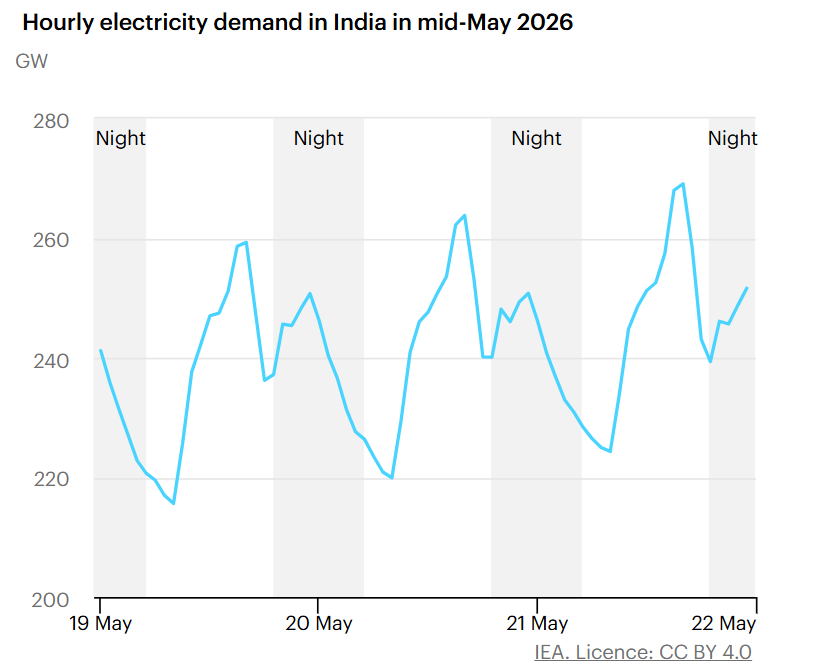
The IEA notes that coal is gradually shifting from a traditional baseload role to a balancing resource that supports grid flexibility and capacity adequacy as renewable penetration increases. This shift raises a broader strategic consideration for policymakers: can coal continue to provide the flexibility a renewable-heavy grid requires over the long term?
Coal plants can operate more dynamically, but frequent ramping reduces efficiency, increases maintenance requirements, and raises operating costs. As renewable penetration has increased elsewhere, many power systems have supplemented or replaced flexible coal operations with alternative balancing resources, including natural gas, energy storage, and demand-response technologies.
Why Most Power Systems Turned to Gas
Germany’s experience offers an important reference point. Over the past two decades, Europe’s largest economy rapidly expanded wind and solar while reducing coal dependence and phasing out nuclear energy. Natural gas became a key balancing resource during periods of low renewable output and sharp demand fluctuations.
This pattern was not unique to Germany. The United States and the United Kingdom followed similar trajectories, where high-efficiency Combined Cycle Gas Turbine (CCGT) plants replaced coal while stabilizing increasingly renewable-heavy grids. Japan also expanded gas-fired generation significantly after the Fukushima disaster to maintain reliability.
CCGT plants became central to such energy transitions because they can ramp output faster than coal plants while maintaining relatively high efficiency. In practice, they provided the operational flexibility required for systems with rising shares of variable renewables.
However, the German experience also highlights the risks of overreliance on imported gas. Following Russia’s invasion of Ukraine, Germany’s dependence on Russian pipeline gas emerged as a strategic vulnerability, forcing a rapid pivot toward LNG imports and supply diversification.
India’s Path to Decarbonization
India is attempting a different route. Unlike many Western economies, it has limited domestic natural gas reserves and remains dependent on imported LNG. Price volatility in global gas markets and energy security concerns have constrained gas use in the power sector, making policymakers cautious about building a transition model reliant on imported fuel. Recent disruptions to energy trade through the Strait of Hormuz have further highlighted the geopolitical risks associated with import dependence.
Industry groups argue that natural gas could still support grid reliability during the transition. “Natural gas can play a pivotal role in the country’s energy transition,” said Paul Everingham, Chief Executive Officer of ANEGA, adding that access to adequate and affordable global gas supplies would be important if India expands gas-fired generation.
Policymakers, however, appear reluctant to anchor long-term planning on imported gas. Instead, India is investing in renewable energy, storage infrastructure, and transmission expansion while seeking to limit structural dependence on imported fuels.
Battery storage costs have fallen sharply over the past decade, and India has accelerated tenders for grid-scale storage projects. Pumped hydro is also emerging as part of a longer-duration balancing strategy. Yet, storage faces both manufacturing and technical constraints. According to the Institute for Energy Economics and Financial Analysis (IEEFA), around 75% of lithium-ion batteries used in India’s electric vehicles are sourced from China. The report also found that only 1.4 GWh of domestic cell manufacturing capacity has been commissioned under the government’s 50 GWh Advanced Chemistry Cell (ACC) Production Linked Incentive program launched in 2021.
Even so, the International Energy Agency argues that batteries may play a larger role in grid balancing than commonly assumed. They can reduce peak demand, ease evening ramping requirements, and support system stability even with limited storage duration. As longer-duration technologies develop and deployment cycles shorten, storage is increasingly being viewed as a credible alternative to some traditional flexibility sources.
This tension helps explain why India continues to invest in coal even as renewable capacity expands rapidly. According to Carbon Brief, the government plans to add 85 GW of new coal-fired capacity over the next seven years. The expansion reflects concerns over reliability and affordability amid rapid demand growth.
Yet the planned coal build-out also raises questions about how India will reconcile near-term energy security needs with its longer-term decarbonization goals. The issue is becoming more urgent as India raises its climate ambition. Under its updated Nationally Determined Contribution (NDC), it has pledged to achieve 60% cumulative installed power capacity from non-fossil sources by 2035 and reduce the emissions intensity of its GDP by 47% from 2005 levels.
Whether storage, transmission upgrades, flexible coal operations, and renewable expansion can collectively provide the flexibility traditionally supplied by gas remains uncertain.
If India succeeds, it could redefine how emerging economies approach decarbonization. The outcome will depend not only on how much renewable capacity is built but also on whether the grid itself becomes flexible enough to support a low-carbon system without creating new dependencies on imported natural gas.