As Germany secures its domestic industry, a historic decline in Western bilateral aid constrains climate finance for developing economies.
By Ankush Kumar
Germany’s €5 billion industrial decarbonization programme comes at a moment of growing strain in global climate finance. Although it became the world’s largest provider of Official Development Assistance (ODA) in 2025, overall international aid flows declined sharply as major donor economies reduced spending. OECD data show that bilateral grants declined from USD 102.5 billion in 2024 to USD 63.5 billion in 2025, highlighting a widening divide between rapidly expanding domestic green-industrial subsidies in advanced economies and increasingly constrained international decarbonization finance. Such grants are direct aid from one country to another that does not require repayment.
How Climate Policy Becomes Industrial Strategy
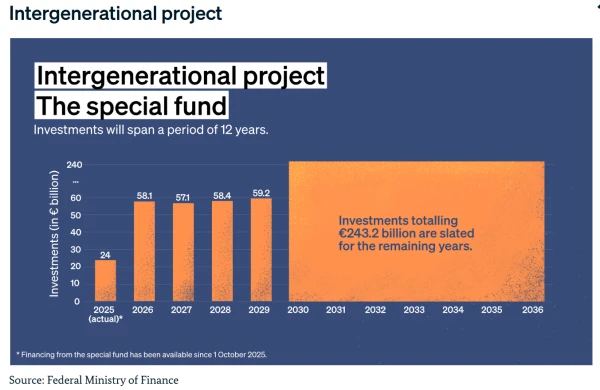
Earlier this month, Berlin launched the second phase of its Carbon Contracts for Difference (CCfDs) programme to support emissions-intensive industries, including steel, cement and chemicals. The mechanism compensates companies for the additional cost of producing low-carbon industrial goods compared with conventional fossil-fuel production. The programme also complements Germany’s broader €500 billion Special Fund for Infrastructure and Climate Neutrality, designed to modernise transport, energy systems and industrial infrastructure. According to Germany’s Federal Ministry of Finance, the fund aims to strengthen long-term economic resilience while accelerating the country’s transition towards climate neutrality.
At the same time, Germany’s latest intervention reflects a broader transformation in climate policy itself. Decarbonization is no longer driven solely by emissions targets and international cooperation. Increasingly, governments are using industrial subsidies, fiscal policy and strategic investment to secure economic competitiveness during the energy transition.
The United States introduced the Inflation Reduction Act with an estimated USD 369 billion in clean-energy incentives, while the European Union responded with the Net-Zero Industry Act to strengthen domestic manufacturing and strategic supply chains. Following the Russian gas crisis, Germany’s industrial sector faced sharply rising energy prices while simultaneously competing with heavily subsidised clean-tech ecosystems in both China and the United States. Consequently, Berlin’s response reflects a wider reality: climate policy has increasingly evolved into industrial policy.
Germany’s infrastructure and climate neutrality fund also illustrates the scale of domestic fiscal mobilisation now shaping industrial decarbonization policy across advanced economies.
International Climate Finance and Access to Capital
For years, international climate negotiations focused on cooperation and historical responsibility under the Paris Agreement. Developed economies are committed to mobilising USD 100 billion annually in climate finance for developing countries. Although developed countries mobilised USD 115.9 billion in climate finance in 2022, according to the OECD, the target was missed for several years after the original 2020 deadline, contributing to persistent trust deficits in global climate negotiations.
The deeper challenge today is whether international climate finance systems can match the scale and speed of domestic green-industrial spending in advanced economies. Germany became the world’s largest provider of official development assistance in 2025 at USD 29.1 billion, overtaking the United States for the first time, according to OECD data. However, its rise reflected a broader contraction in global aid flows rather than a major expansion in spending. German ODA itself declined from USD 32.9 billion in 2024, while US ODA fell dramatically from USD 65.5 billion to USD 29 billion in 2025. The OECD also noted that the five largest donor countries — Germany, the United States, the United Kingdom, Japan and France — all reduced aid spending in 2025, accounting for 95.7% of the total decline in global ODA.
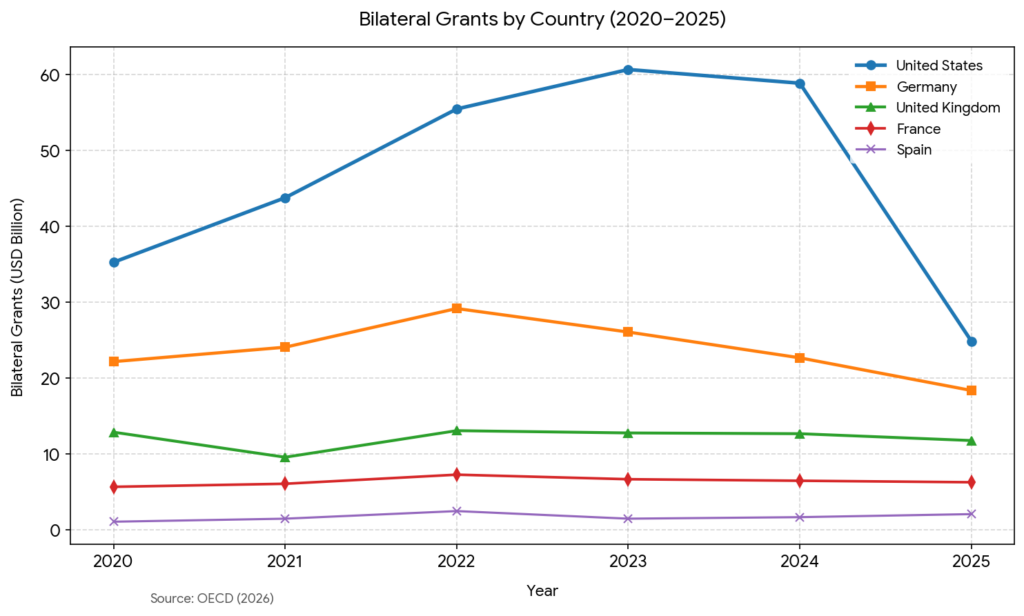
Meanwhile, OECD DAC data show an unprecedented multi-year drop in bilateral grant funding across almost all featured nations. This trend is anchored by the United States, where grants fell by over half to USD 24.9 billion in 2025 compared with the previous year, alongside steady funding pullbacks from Germany. Meanwhile, bilateral grants from the United Kingdom, France, and Spain remained largely stagnant, reinforcing a broader global retreat in direct development aid.
The contrast is increasingly stark: while advanced economies deploy hundreds of billions in domestic green-industrial subsidies, international climate-finance systems for developing economies are showing signs of fiscal strain.
The financing pressures are increasingly visible across emerging markets and developing economies (EMDEs), a group that includes developing and emerging economies outside advanced industrialised nations. Indonesia’s USD 20 billion Just Energy Transition Partnership (JETP), announced in 2022, relies on a complex structure involving donor governments, multilateral banks and private capital mobilisation. Yet implementation has progressed more slowly than expected, with several coal-retirement financing arrangements facing delays and funding uncertainty, according to the International Energy Agency (IEA).
Bangladesh, meanwhile, faces delays in climate finance disbursement and declining access to concessional lending, increasing dependence on more expensive market-based borrowing, according to research from Transparency International Bangladesh.
IEA also suggests that annual clean-energy investment in EMDEs outside China must rise from roughly USD 320 billion today to more than USD 2.2 trillion by the early 2030s if global climate and development goals are to remain achievable.
The scale of that investment gap increasingly defines the future of global decarbonization and the effectiveness of international climate finance systems.
Simultaneously, geopolitical tensions are reshaping fiscal priorities across advanced economies. The United Kingdom is reducing climate-finance spending in real terms, while several advanced economies, including Canada, are facing growing fiscal pressure as defence and industrial spending rise. Together, these trends point to a widening divergence between rapidly expanding domestic decarbonization policy and increasingly constrained international climate finance flows.
Consequently, the global energy transition is evolving into more than an environmental project. It is increasingly becoming a contest over industrial capacity and fiscal power. While advanced economies can subsidise decarbonization at an unprecedented scale, many developing economies remain dependent on constrained climate finance and volatile external capital flows. Unless international financing expands alongside domestic green-industrial spending, the transition risks becoming increasingly unequal. The defining divide in the energy transition may ultimately be not ambition, but access to capital.