As Canada deepens ties with Europe, its distinctive mix of clean electricity, fossil fuel dependence, and critical minerals becomes increasingly relevant to the continent’s industrial strategy.
By Editorial Desk
Europe is looking for energy security, critical minerals, clean technologies, and resilient supply chains. Canada has many of the resources Europe needs, but its power system has been built on a very different foundation.
That contrast could become one of the most interesting parts of the deepening Canada–EU relationship.
The political signal is already significant. European Commission president Ursula von der Leyen has proposed that Canada become the EU’s first “associate member,” while Canadian prime minister Mark Carney has welcomed the idea and called for deeper cooperation in areas including critical minerals and energy security. The precise form of such a relationship remains to be defined: there is currently no established EU treaty category of “associate membership,” and Carney has said Canada is not seeking full EU membership.
But beneath the geopolitics is a more practical question: what happens when Canada’s resource strength meets Europe’s industrial decarbonisation agenda?
Five very different electricity systems
The first striking difference is Canada’s dependence on hydro.
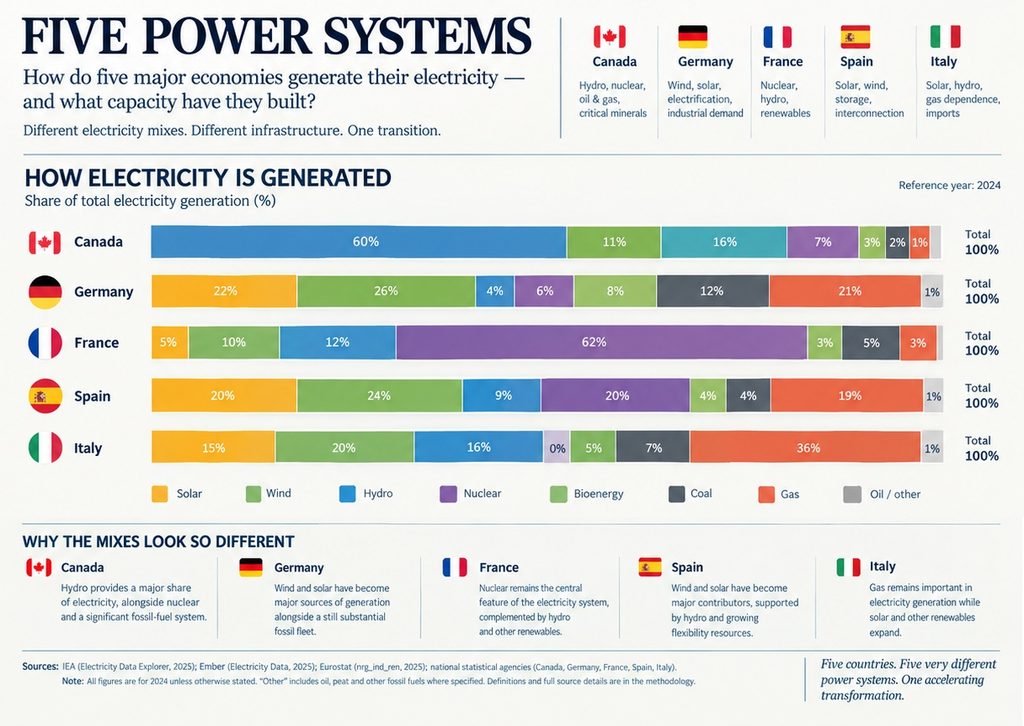
Hydropower accounts for 60% of Canadian electricity generation in the infographic. Wind contributes 11%, gas 16%, nuclear 7%, bioenergy 3%, coal 2%, solar 1% and oil/other sources 1%.
That makes Canada unusual among the five countries. Its clean-electricity foundation is dominated by a large existing hydro system rather than by the rapid expansion of wind and solar that has reshaped several European markets.
The distinction matters because clean electricity is only one part of the energy transition. A country can have a relatively low-carbon power system while still relying heavily on fossil fuels across transport, buildings and industry.
Germany, by contrast, has built a much larger wind-and-solar system, where wind remains at 26% of generation and solar at 22%, alongside nuclear at 6%, bioenergy at 8%, coal at 12% and gas at 21%.
Spain has also built substantial variable renewable generation, with 24% wind and 20% solar, while nuclear supplies 20% and gas 19%. France is the outlier in another direction: 62% of its electricity comes from nuclear, with hydro at 12%, wind at 10% and solar at 5%.
Italy has a more gas-dependent system. Gas accounts for 36% of generation, while wind provides 20%, solar 15%, hydro 16% and bioenergy 5%.
These are not simply different speeds of the same transition. They are different power-system architectures.
Different systems create different opportunities
This is where the comparison becomes relevant to the emerging Canada–EU relationship.
Canada brings a power system with a very large hydro base, alongside nuclear, gas resources and substantial critical-mineral potential. European economies bring enormous markets for clean technologies, electrification and industrial equipment, together with experience scaling wind, solar, grids and other parts of the energy transition.
The opportunity is less about exporting one energy model to the other than about connecting capabilities: Canadian resources and clean power with European technology, manufacturing capacity and industrial demand. In June, the EU and Canada held an Energy Security Business Roundtable focused on electrification, clean-energy technologies, electricity grids, critical components and investment, as well as Canada’s potential role in European energy security. The next EU–Canada summit is scheduled for 29–30 October 2026 in Canada.
That creates possible areas of cooperation across batteries and critical minerals, electricity infrastructure, hydrogen, nuclear supply chains and clean manufacturing. But the underlying systems matter: technology that works well in a wind-and-solar-heavy market is not automatically the same technology or investment model required in a hydro-dominated one.
The decarbonisation challenge remains
Canada’s advantage in electricity generation should not be confused with a fully decarbonised energy economy.
The Canadian government’s current target remains a 40–45% reduction in greenhouse-gas emissions below 2005 levels by 2030, followed by net zero by 2050. Official data put Canada’s emissions in 2023 at 14% below 2005 levels.
But Canada is not alone in facing the harder next phase of the transition. Across energy systems, the challenge is increasingly about what happens beyond clean generation: legacy grids need modernisation and expansion; electrification remains relatively low; wind and solar bring seasonal and weather-dependent variability; batteries provide limited-duration storage; and affordable green alternatives remain scarce in sectors such as heavy industry, shipping and aviation.
Canada and Europe start from different positions. Canada has a large clean-power asset in hydro; Germany and Spain have built extensive wind and solar capacity; France has nuclear at the centre of its system; Italy remains heavily reliant on gas.
The emerging Canada–EU relationship therefore raises a more interesting question than who has the “better” energy transition.
It is how different power systems can connect through investment, technology, infrastructure, supply chains and industrial decarbonisation.