The AfD wants to halt Germany’s coal phase-out and reverse key parts of the Energiewende. But as renewables reshape the power system, the bigger question is whether turning back to coal can deliver the reliable and affordable electricity the party promises.
The Alternative for Germany (AfD) won 43.8% of the vote in Sunday’s Saxony-Anhalt state election, its strongest result in a German state election. Energy was only one issue in the campaign, but the party has made a sharp break by making Germany’s energy transition a crucial part of its economic message. Its argument is simple: keep coal, expand gas and reverse parts of the Energiewende to make electricity cheaper and industry more competitive.
The harder question is whether coal can actually deliver that promise.
The AfD’s plan: keep coal beyond the phase-out
Germany is legally required to end coal-fired power generation by 2038 at the latest, covering both hard coal and lignite. But Saxony-Anhalt’s remaining lignite generation is already scheduled to end earlier. The state’s main lignite power station at Schkopau is due to close by the end of 2034.
The AfD wants to reverse that trajectory. Its state election programme calls for a “180-degree” change in energy policy, including an end to the coal phase-out, a halt to further wind expansion and a greater role for coal, gas and nuclear power. It argues that lignite can reduce electricity prices, provide reliable generation, strengthen grid stability, reduce dependence on imports and protect industrial jobs.
The proposal goes beyond simply keeping existing plants open. The AfD also envisages maintaining coal sites beyond the current phase-out timetable and using imported lignite once domestic reserves are exhausted.
Coal is shrinking — but the argument for it remains
The economic case for coal also needs context. Employment in German coal and lignite mining fell from 17,468 people in 2015 to 6,661 in 2024, according to D-EITI.
That does not mean coal has lost all economic importance. Germany still needs reliable power for an industrial economy, particularly when wind and solar output is low. But the coal industry is much smaller than it was a decade ago, while the power system around it has changed substantially.
Germany has also already moved beyond its nuclear era. The final three nuclear reactors shut down on 15 April 2023. Nuclear power accounted for about 6% of gross electricity generation in 2022, compared with 86.8 TWh, or 14.1%, in 2015.
Would more coal actually make electricity cheaper?
Coal is not automatically cheap.
Coal plants still pay for fuel, operation and maintenance, as well as the EU carbon price. Wholesale electricity prices are also often set by the most expensive power plant needed to meet demand at a given moment—not by the average cost of all electricity being generated.
That means keeping more coal capacity online does not necessarily translate into lower electricity prices for consumers.
Germany’s electricity system has already changed dramatically. Renewables supplied 55.3% of electricity consumption in 2025, with wind remaining the largest source and solar overtaking gas and lignite.
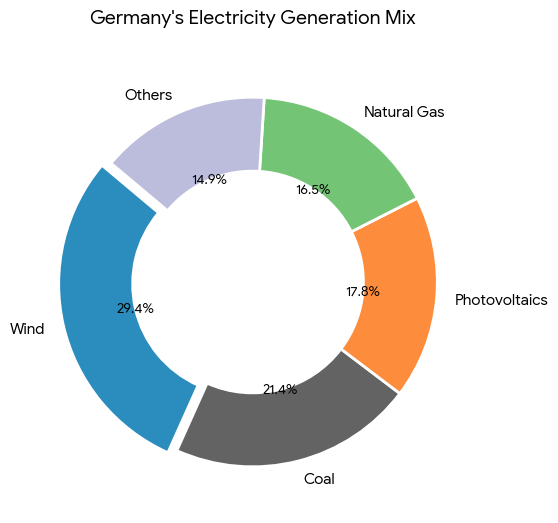
This matters because the price debate is no longer taking place in the electricity system Germany had a decade ago. Renewable generation can push wholesale prices sharply lower when wind and solar output is high. The challenge comes when that power is not available where or when it is needed.
Germany is not simply forcing coal out
The coal decline is also not happening only because of government bans.
On 1 September 2026, the Federal Network Agency said it would impose no new coal-fired operation ban for 2026. Enough coal capacity had already left the market to put Germany below the legally defined 2029 target, while planned lignite closures are sufficient to meet that target without another regulatory shutdown.
That distinction matters. Some coal capacity is disappearing through the statutory phase-out, but plants are also leaving the market as their economics change.
Saxony-Anhalt illustrates the transition. Schkopau is scheduled to close its coal operation in 2034, while a roughly 900 MW gas-and-steam plant is being developed at the site. The planned replacement is designed to be hydrogen-ready and provide system services to the grid.
Why the bigger challenge is flexibility
Germany consumed 864 TWh of natural gas in 2025. That was about 1.6 times the country’s total electricity consumption. Most gas was not used to generate electricity: 60% went to industry and 40% to households and commercial users.
Gas nevertheless matters for the power system. It accounted for 16.1% of domestic electricity production in 2025, up from 14.8% in 2024. Germany also depends heavily on imports for its gas supply.
The renewable system therefore faces a different problem from simply producing more electricity. Germany must make renewable power available when consumers need it.
The latest DIW Energiewende-Monitor shows progress in solar, wind and battery storage, but the expansion rate remains uneven. Solar deployment is running at around 79% of the pace required to meet the 2030 path, while onshore wind is at 42% and offshore wind at 52%. Large-battery additions almost doubled in the first half of 2026.
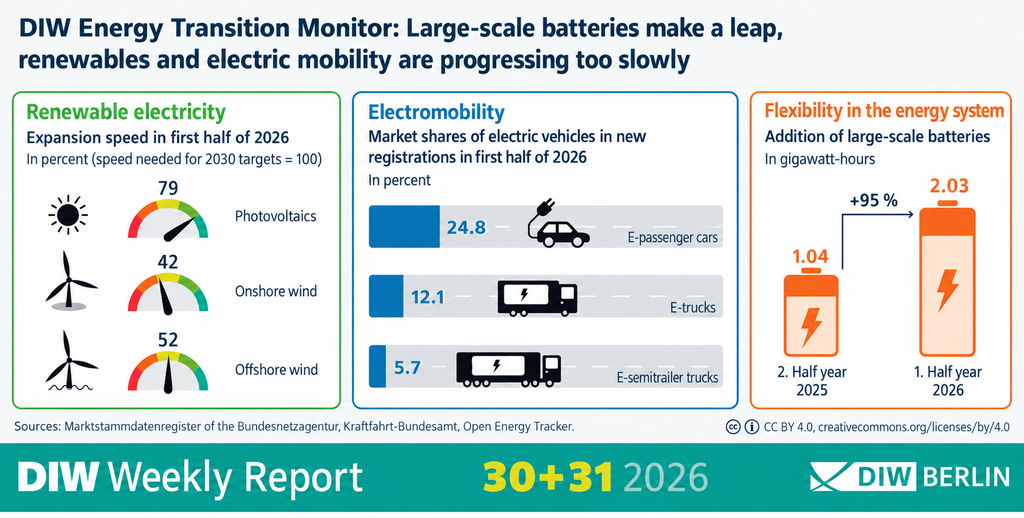
The pattern is becoming clearer: Germany can produce very cheap electricity when renewable output is high, but it needs more storage, grid capacity, flexible demand and dispatchable generation to manage the hours when output falls.
The other economic argument
The energy transition is also becoming an economic sector in its own right.
After the Saxony-Anhalt election, the German Renewable Energy Federation (BEE) warned that AfD participation in government could seriously threaten further progress on the energy transition. The organisation estimates that renewables already support around 26,000 jobs in the state and generate more than €170 million in regional value creation.
That creates a second economic question. Ending or slowing renewable investment would not simply protect existing coal-related activity. It could also affect a growing industry built around wind, solar, batteries, grids and related services.
Germany has reduced greenhouse-gas emissions by 48.2% from 1990 levels. The country’s legal targets require at least a 65% reduction by 2030 and climate neutrality by 2045.
The political argument is therefore no longer simply about whether Germany should have coal. It is about which combination of technologies can deliver affordable and reliable electricity while meeting those targets.
Can coal solve the AfD’s energy problem?
Coal can provide firm, dispatchable power. That is a real advantage, particularly when renewable output is low.
The AfD is identifying a genuine weakness in Germany’s energy system: electricity must remain reliable and affordable even when wind and solar output falls. But extending the life of coal is only one possible response, and it does not automatically produce cheaper electricity.
Germany’s bigger test is whether it can build enough grids, storage, flexible demand and reliable backup capacity to make abundant renewable electricity available when consumers need it. The AfD is asking Germany to look back to coal. The more difficult task may be making the new system work.