As land constraints slow conventional solar expansion, India and Germany are demonstrating how floating solar can unlock new opportunities through policy, engineering and international collaboration
For decades, solar power has expanded primarily through ground-mounted utility-scale projects and rooftop photovoltaic systems. However, as competition for land intensifies, a third approach is gaining momentum. The World Bank describes floating photovoltaics (FPV) as a potential “third pillar” of solar deployment, complementing conventional ground-mounted and rooftop systems.
The world’s extensive network of man-made reservoirs offers terawatt-scale development potential. Research based on the World Bank’s assessment suggests that covering just one percent of the world’s surface waters could support approximately 400 GWp of floating solar capacity.
Floating solar, together with agrivoltaics, offers countries an opportunity to expand renewable electricity generation without placing additional pressure on agricultural land or urban development. While floating photovoltaic systems generate electricity on reservoirs and other inland water bodies, agrivoltaics integrate solar panels with farming activities, enabling productive land to serve multiple purposes. As governments search for ways to balance clean energy expansion with land-use constraints, both technologies are attracting increasing policy and industry attention.
Even in Germany, where environmental regulations limit deployment, studies by Fraunhofer ISE estimate that artificial water bodies alone could support around 44 GWp of floating solar capacity, highlighting the long-term opportunity if technical and ecological challenges can be addressed.
This growing interest is reflected in a new collaboration between Germany’s Fraunhofer Institute for Solar Energy Systems (ISE) and Himachal Pradesh University (HPU). On July 30, the two institutions signed a Memorandum of Understanding (MoU) to advance joint research on floating photovoltaics and agrivoltaics.
Germany brings decades of expertise in solar engineering and materials research, while India provides one of the world’s most diverse testing environments across different climates, reservoirs and regulatory conditions. By combining these complementary strengths, the partners aim to generate operational data that can improve system reliability, strengthen investor confidence and accelerate the commercial deployment of floating solar
India Scales Floating Solar Through Policy
For India, floating solar supports a much broader energy transition.
The country aims to install 500 GW of non-fossil fuel electricity capacity by 2030, making every available renewable resource increasingly valuable.
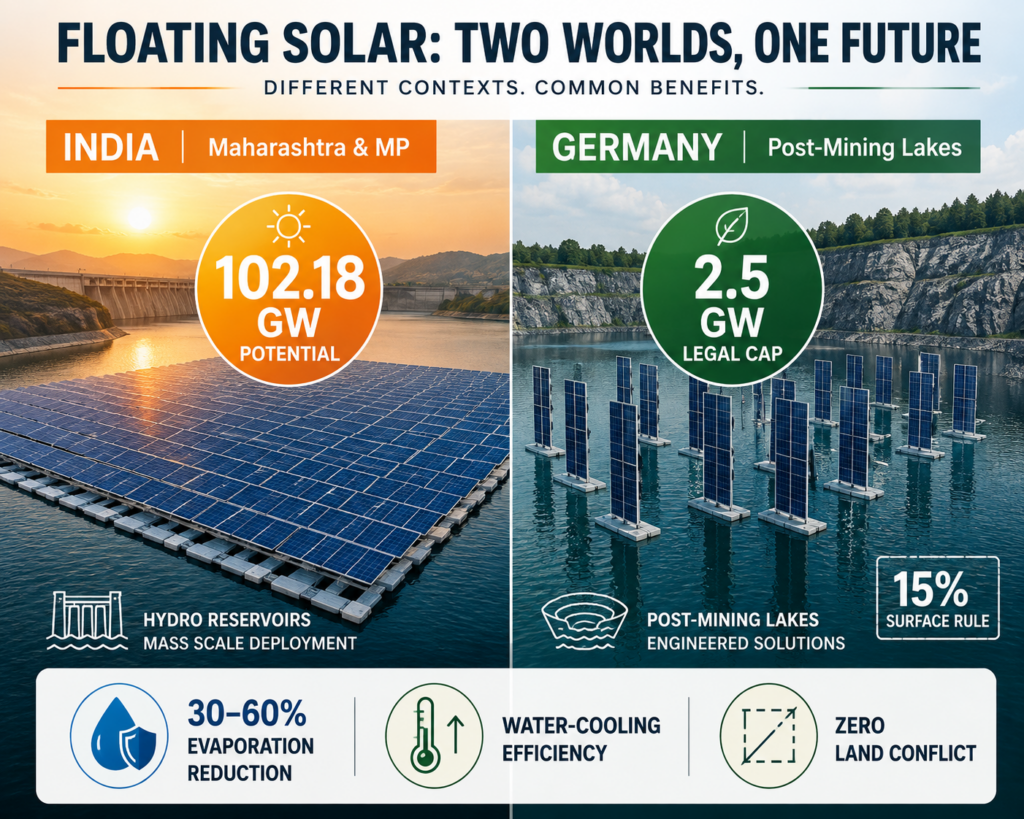
According to the National Institute of Solar Energy (NISE), India has an estimated 102.18 GW of floating solar potential across reservoirs and other inland water bodies. Yet only about 700 MW has been deployed, highlighting the gap between technical potential and commercial implementation.
To help bridge that gap, the Indian government recently approved the Pradhan Mantri Surya Sarovar Yojana (PM-SSY) with a total outlay of approximately US$590 million (INR 5,070 crore). The scheme aims to support the development of 5000 MW of floating solar capacity, paired with 10,000 MWh of battery energy storage, between FY2026-27 and FY2030-31.
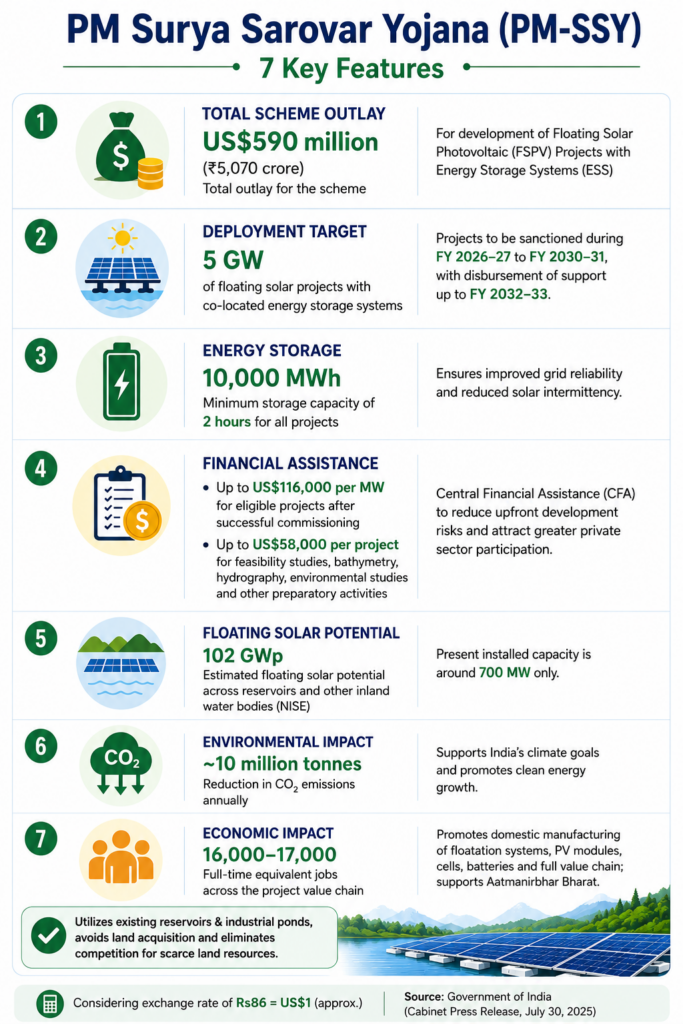
Rather than funding projects outright, the programme aims to reduce investment risk. Eligible projects will receive Central Financial Assistance (CFA) of around US$116,000 per MW after commissioning. Developers can also access up to US$58,000 per project. This support can cover feasibility studies, bathymetric and hydrographic surveys, environmental assessments and other preparatory work.
By lowering upfront development costs, the scheme aims to attract more private investment. The programme also requires battery storage, which is intended to improve grid reliability. It could also allow renewable electricity to be supplied beyond daylight hours.
Germany Focuses on Smarter Engineering
While India is emphasizing large-scale deployment, Germany is addressing a different challenge: improving the integration of solar energy into the grid.
Rapid growth in rooftop and utility-scale solar has created periods of abundant midday electricity. This occasionally pushes wholesale electricity prices into negative territory and place greater pressure on transmission networks. Rather than simply adding more capacity, German engineers are redesigning floating solar systems to match electricity demand.
One example is SINN Power’s floating solar installation at the Jais gravel lake in Bavaria. The 1.87 MW project uses 2,600 bifacial solar modules mounted vertically in an east-west orientation. Unlike conventional tilted panels that generate most of their electricity around midday, the vertical configuration increases electricity production during the morning and evening, when demand and market prices are typically higher.
The installation also minimizes environmental impacts. It occupies only 4.65% of the lake’s surface, well below Germany’s legal 15% limit designed to protect aquatic ecosystems. Floating anchoring systems allow the structure to adapt to changing water levels while avoiding major disturbance to the lakebed.
Early operating results have been encouraging. By supplying electricity directly to a nearby gravel processing facility, the installation has reduced grid electricity consumption by nearly 60%, with long-term reductions expected to approach 70%.
A Shared Direction for Floating Solar
Although India and Germany are pursuing different strategies, both point toward the same conclusion.
India is using public policy and financial incentives to scale floating solar, while Germany is demonstrating how engineering innovation can improve system performance and grid integration. Together, they illustrate that the future of floating solar depends not only on building more projects but also on improving their economics, reliability and environmental performance.
The new Fraunhofer-HPU partnership brings those complementary strengths together. India’s large pipeline of reservoir-based projects provides an ideal environment for testing new technologies at scale. Meanwhile, Germany’s expertise in engineering and materials research can help improve system design under a wide range of operating conditions.
As governments search for new ways to balance energy security, decarbonization and land use, harvesting both sun and water may become one of the defining features of the next generation of renewable energy development.