The atmosphere is borderless, but the bill for climate damage is not. Nepal’s disaster brings that contradiction into sharp focus.
By Ankush Kumar
Imagine a container ship arriving at a national border. Its cargo is inspected, declared and cleared through customs before it enters the country. Goods can be stopped at the border. Greenhouse gases cannot.
CO₂ released from a factory thousands of kilometres away does not present a passport, cross through customs or stop at a national boundary. Once in the atmosphere, it becomes part of a global system shared by every country.
That makes Nepal’s latest disaster more than a story about floods, glaciers and reconstruction. It raises a bigger question: if the atmosphere is shared by all, should climate responsibility be limited by national boundaries?
On August 26, a catastrophic collapse of ice and rock triggered a devastating flash flood along Nepal’s northern border with China. By September 3, at least 1,252 people had been reported dead and more than 4,200 remained missing. Around 20,000 homes are expected to require rebuilding, with infrastructure costs estimated at roughly US$2.56 billion.
Nepal’s Foreign Minister, Shisir Khanal, raised the issue of climate justice post the disaster, highlighting Nepal’s vulnerability despite its relatively small contribution to global emissions. Earlier reports interpreted his remarks as a call for compensation from major emitting countries, including China, India and the United States. However, Khanal later clarified that Nepal was not seeking compensation from any specific country. In a September 3 statement, the Chinese Embassy in Nepal said Khanal wanted Nepal to pursue climate-related compensation from the international community through the framework of the UNFCCC and the Paris Agreement.
Therefore, Nepal’s position could not be read as a claim that emissions from any one country caused this particular disaster. The immediate event involved a glacier-related collapse and subsequent flooding. Establishing whether human-caused warming made such an event more likely or more severe is a separate scientific question from attributing it to the emissions of a particular country.
That distinction matters. But so does the question that Nepal and many other climate-vulnerable countries continue to raise: If climate change is a global problem, while its worst consequences often fall on countries with limited emissions and limited financial capacity, who should bear the cost?
Nepal and the climate-justice dilemma
Nepal emitted just 18.8 million tonnes of CO₂ in 2024 — about 0.05% of the global total. Per person, that was roughly 0.63 tonnes, compared with about 14 tonnes in the United States.
Yet Nepal sits on the frontline of climate risk. Its mountains, glaciers and river systems make it particularly vulnerable to floods, landslides and other climate-related hazards.
For a country with limited financial resources, one catastrophic event can wipe out years of development. Adaptation can reduce the risk, but it cannot eliminate every loss.
That is where loss and damage enters the debate. When a disaster destroys homes, livelihoods and infrastructure beyond what adaptation can prevent, a difficult question remains: who should help pay the bill?
Three countries, three different carbon stories
China, the United States and India are central to this debate because all three are among the world’s largest current emitters, but their carbon stories are very different.
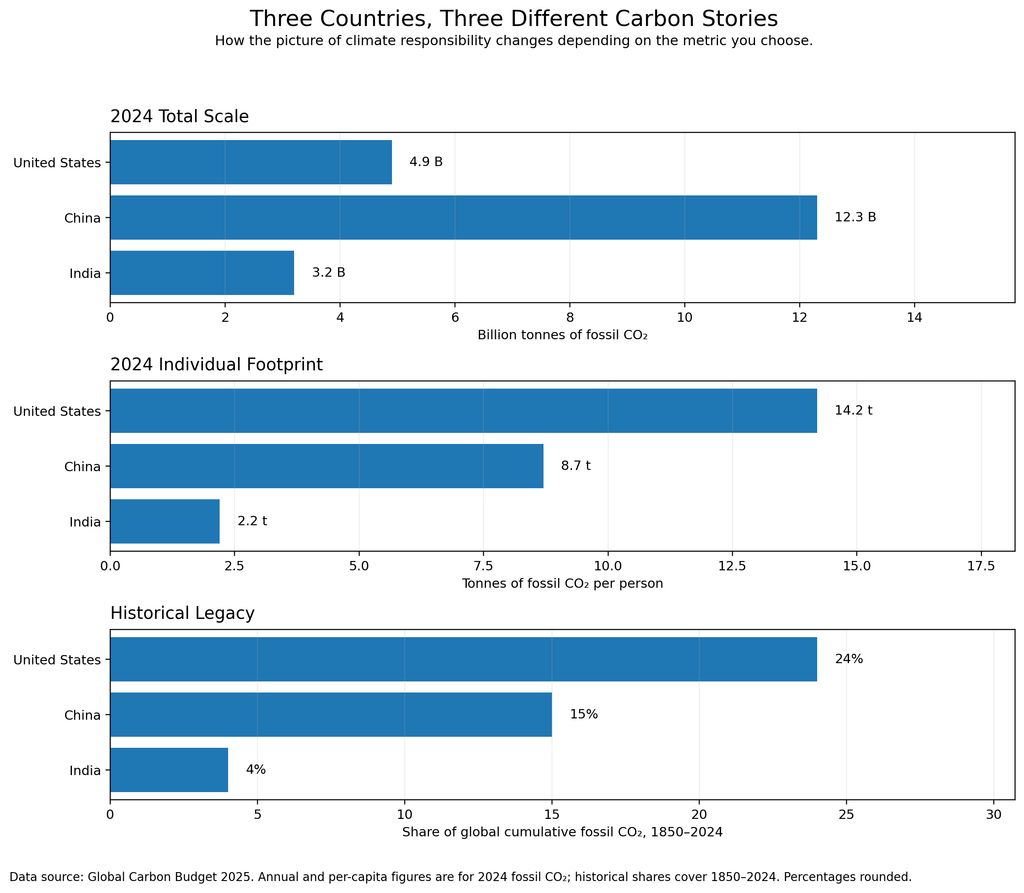
According to the Global Carbon Budget, an annual scientific assessment produced by the international Global Carbon Project research consortium, China accounted for about 32% of global fossil CO₂ emissions in 2024, with approximately 12.3 billion tonnes. The United States produced about 4.9 billion tonnes, or 13%, while India produced about 3.2 billion tonnes, or 8%.
Per person, however, the picture changes dramatically. In 2024, fossil CO₂ emissions were approximately 14.2 tonnes per person in the United States, 8.7 tonnes in China and 2.2 tonnes in India.
History changes the picture again. Between 1850 and 2024, the United States accounted for about 24% of cumulative global fossil CO₂ emissions, compared with 15% for China and roughly 4% for India.
So who should pay?
The answer depends on what we mean by responsibility. Should it follow today’s emissions, historical emissions, emissions per person, a country’s wealth and ability to pay, or the vulnerability of the country suffering the damage?
There is no single number that answers all of those questions.
What does the Paris Agreement say?
The Paris Agreement does not create a system in which one country can send another country a bill for a particular flood or landslide. It does, however, establish a framework based on equity and the principle of common but differentiated responsibilities and respective capabilities, taking different national circumstances into account.
Its central goal is to hold the increase in global average temperature well below 2°C above pre-industrial levels while pursuing efforts to limit warming to 1.5°C.
That principle is at the heart of the climate-justice debate. All nations share responsibility for tackling climate change, but they did not reach this level with the same history, emissions, resources, or exposure to climate risks. In simple terms, the Paris Agreement recognises that countries have a common problem, but not necessarily an equal share of the responsibility or the same ability to respond.
Climate finance: promises and reality
Money is where climate responsibility becomes much less abstract.
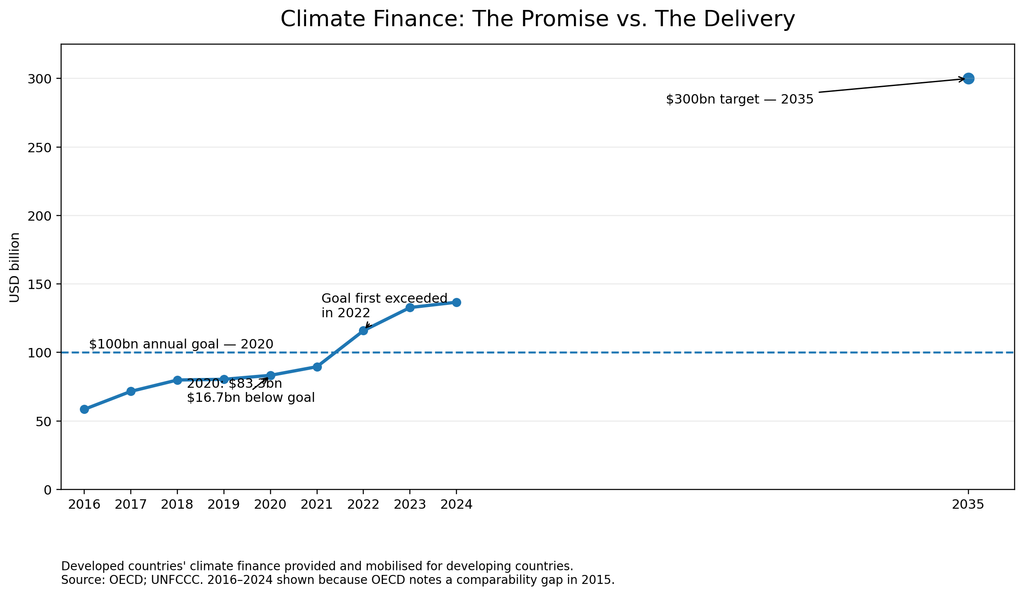
Developed countries had pledged to mobilise US$100 billion a year in climate finance for developing countries by 2020. According to the OECD, that target was reached for the first time in 2022, when US$115.9 billion was provided and mobilised. The figure rose to US$132.8 billion in 2023 and US$136.7 billion in 2024.
But the headline number does not tell the whole story. Climate finance can come as grants and loans, as well as private finance mobilised through public funds. For countries such as Nepal, the question is not simply how much money is pledged, but whether it reaches those most vulnerable to climate impacts, whether it is accessible, and whether the terms are manageable.
At COP29 in 2024, countries agreed to a new goal of at least US$300 billion a year in climate finance for developing countries by 2035, with developed countries taking the lead. They also called for efforts to scale up finance from public and private sources to US$1.3 trillion a year by 2035.
The numbers are bigger. But so are the needs.
From aid to responsibility?
The Fund for Responding to Loss and Damage, operationalised at COP28, was created to help particularly vulnerable developing countries deal with economic and non-economic losses from climate change, including extreme weather and slow-onset events.
But there is an uncomfortable gap between the promise of climate finance and where the money reaches. Climate finance remains concentrated in middle-income countries, while support for low-income countries was just US$9.6 billion in 2024, down from US$11.1 billion in 2022.
For Nepal, that distinction matters. Aid can help after a disaster. Adaptation can reduce future risks. But when the damage overwhelms both, who pays for the loss?
Nepal’s position does not prove that emissions from any one country caused this particular disaster, nor does it settle who should pay. It does, however, expose a central problem of climate justice: the countries facing some of the greatest risks are not necessarily the countries with the greatest financial capacity or historical responsibility.